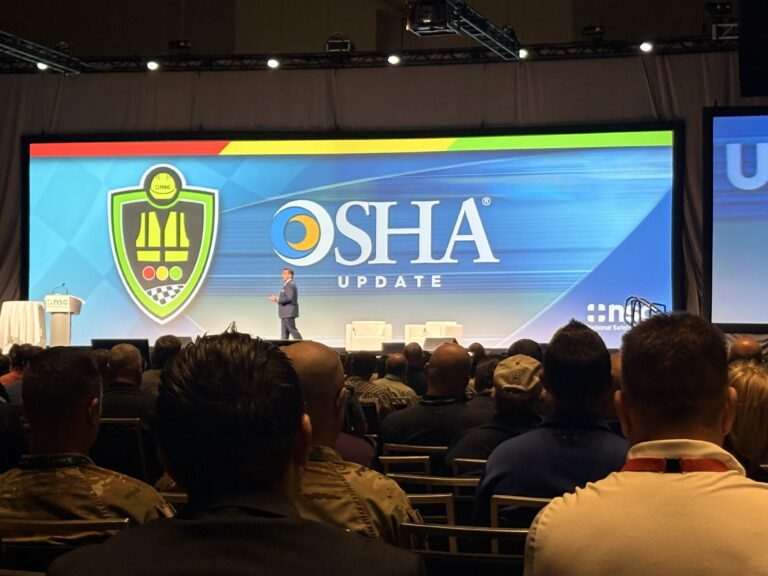
When a sitting OSHA administrator tells a room full of safety professionals that the agency’s flagship hazardous-energy standard hasn’t been touched since he was in high school, it is worth pausing to ask what comes next. That was the substance of David Keeling’s remarks on Lockout-Tagout (LOTO) during his keynote at the 2026 NSC Safety Congress & Expo (Ferguson). For organizations already looking into Digital LOTO Systems, the timing and tone of his comments deserve a closer look.
OSHA Is Listening Before It Legislates
Keeling’s most concrete disclosure was procedural, not political: OSHA convened three separate stakeholder meetings on Lockout-Tagout in the week before his keynote, specifically to determine what groundwork needs to happen before the agency enters formal rulemaking (Ferguson). As he put it, the meetings were called “to talk about Lockout-Tagout and what we needed to do before we got into the rulemaking conversation.”
Rulemaking under the Occupational Safety and Health Act is a procedurally heavy process, one that typically begins only after an agency has a reasonably clear thesis about what a revised standard should contain. By running stakeholder input ahead of that thesis, OSHA is signaling that the shape of a modernized LOTO standard is still genuinely open, and that the agency wants operational reality, not just legal precedent, to inform it.
The Standard's Age Is the Argument
Keeling was direct about why this matters now. The current Lockout-Tagout standard, codified at 29 CFR 1910.147, dates to 1989 (United States, Occupational Safety and Health Administration). Keeling underscored this personally by noting that the last substantive update happened while he was still in high school. A standard written for an industrial landscape of breaker panels, padlocks, and paper logs was never built to anticipate the control systems, sensors, and connected devices that now sit inside most hazardous-energy workflows.
Keeling framed this gap explicitly as a call to look at “things that are more effective than maybe the traditional way of process”. His statement opens the door to methods beyond the manual lock-and-tag procedures the standard currently assumes as the default.
Field Experience Over Washington Assumptions
The second thread running through Keeling’s remarks was about who should be doing the informing. He was candid that policy shaped primarily inside the Beltway risks missing what is actually happening on plant floors: “Best decisions don’t always come out of D.C. We’re too far away to know what’s going on.” His stated intent is for exhibitors, solution providers, and practitioners with direct field experience to shape how OSHA thinks about LOTO modernization — not as an afterthought to a drafted rule, but as an input to it.
For an agency about to take on a 35-plus-year-old standard, that is a notable posture. It suggests the rulemaking record OSHA eventually builds will weigh operational evidence — what has actually reduced incidents, improved compliance consistency, or closed documentation gaps in practice — more heavily than it might have in a purely internally driven process.
Where Smartlox Fits Into This Conversation
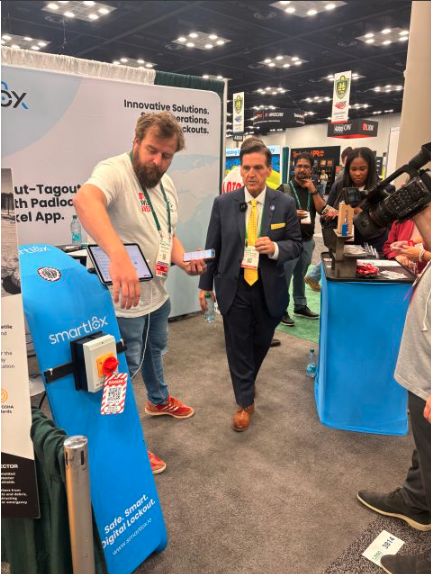
This is precisely the terrain Smartlox has been operating in. Digital Lockout-Tagout does not ask organizations to abandon the compliance obligations set out in 1910.147 — isolation, verification, and authorized removal remain the core requirements, and nothing about Keeling’s comments changes that. What Smartlox changes is the reliability and visibility of how those requirements are executed in practice:
- Process consistency. Digitized procedures reduce the variability that comes with paper checklists and memory-dependent steps, letting teams lock on and lock of digitally so the same sequence is followed the same way, every time, across shifts and sites.
- Real-time visibility. Supervisors and safety managers can monitor live isolation status across every lock on site, seeing what’s locked out, by whom, and for how long, rather than reconstructing that picture after the fact from a logbook.
- Auditable documentation. Every lock application, verification, and removal generates a tamper-proof, timestamped audit trail automatically, producing defensible evidence without the administrative burden of manual entry.
- Proactive safety management. Aggregated data across lockout events surfaces patterns — recurring bottlenecks, frequently isolated equipment, or procedural drift — that a paper-based system simply cannot expose until something has already gone wrong.
None of this is a substitute for the fundamentals of hazardous energy control. It is an argument for what “more effective” can look like in practice, at a moment when the agency setting the standard has explicitly said it wants to hear that argument from people who have implemented it. Smartlox has laid out its own view of that intersection in more detail in itz white paper, Digital LOTO Under OSHA (Smartlox, Digital LOTO).
The Takeaway
The the signal is unambiguous: OSHA is aware its LOTO standard predates the technology now used to comply with it, and it is actively soliciting the kind of field-level input that companies deploying Digital LOTO systems are well positioned to provide. For safety leaders evaluating where to invest next, that is a reason to pay attention. Learn more about how Nyckel by Smartlox applies these principles today.
Works Cited
Ferguson, Alan. “David Keeling Lays Out His Vision for OSHA’s Future in Occupational Keynote.” Safety+Health Magazine, National Safety Council, 15 Sept. 2026, www.safetyandhealthmagazine.com/david-keeling-lays-out-his-vision-for-oshas-future-in-occupational-keynote/.
“Nyckel Digital Lockout-Tagout.” Smartlox, Siemens, www.siemens.com/en-us/products/smartlox-nyckel-digital-lockout-tagout/.
Smartlox. Digital LOTO Under OSHA. Siemens, assets.new.siemens.com/siemens/assets/api/uuid:4f440e36-91dd-4cce-95c4-1612ac8a151f/digital-lotowhitepaper.pdf.
United States, Occupational Safety and Health Administration. “1910.147 – The Control of Hazardous Energy (Lockout/Tagout).” U.S. Department of Labor, www.osha.gov/laws-regs/regulations/standardnumber/1910/1910.147.