Audit-Ready by Default: How Digital LOTO Simplifies Compliance for Manufacturing Safety Teams Ask any manufacturing safety manager what happens when an audit is announced, and you’ll hear a similar story: a scramble to pull together sign-off sheets, cross-check who locked what, and hope nothing was missed. Paper-based Lockout-Tagout creates risk on the floor and on paper, long after the job is done. Digital Lockout-Tagout changes what “audit-ready” means. Instead of reconstructing a record, you pull one instantly. Where paper compliance breaks down Handwritten tags and forms are easy to misplace, backdate, or fill in incorrectly. There’s no single source of truth for who is currently locked out of a piece of equipment. Proving compliance after the fact means manually cross-referencing multiple paper logs. Regulatory standards (from OSHA in the US to equivalent workplace health and safety frameworks internationally) increasingly expect a documented, defensible process, not just a completed one. What a digital audit trail actually looks like With Smartlox, every step of a Lockout-Tagout procedure is captured automatically the moment it happens. The Nyckel platform logs who applied a lock, when, to which isolation point, and who authorized its release — creating an irrefutable digital audit trail, retrievable in seconds rather than reconstructed over days. Traditional LOTO Smartlox Digital LOTO Benefit Paper sign-off sheets Automatic digital logging of every lock and release Tamper-resistant, audit-ready records by default Manual cross-referencing during audits Real-time lockout reports in the Nyckel Web App Compliance checks take minutes, not days Unclear accountability for re-energization risk Unique digital sign-off per worker, per isolation Removes ambiguity from who authorized what It’s also built to fit into what your site already runs. Smartlox offers robust API capabilities for integrating Digital LOTO with existing safety management systems and machinery controls, so compliance data doesn’t live in a silo — it becomes part of the same reporting your team already relies on. Compliance as a byproduct, not a project The sites that get the most value from Digital LOTO aren’t running a separate “compliance initiative.” They’ve simply made the day-to-day lockout process one that documents itself. For a safety leader, that’s the real win: less time spent proving you were compliant, and more confidence that you actually were. Ready to elevate your manufacturing safety? Book a demo to see Digital Lockout-Tagout on your own floor, or read the full whitepaper for a look at how the Nyckel platform and Bluetooth Padlocks work together. Book a demo: https://calendly.com/d/cwft-vpj-z73/smartlox-discovery-call Read the whitepaper: https://smartlox.io/wp-content/uploads/2026/02/SL-WP-3-02-V2-.pdf Learn more about Digital LOTO for manufacturing: https://smartlox.io/manufacturing/
OSHA’s New Chief Signals an Opening for Digital Lockout-Tagout — Here’s What It Means
When a sitting OSHA administrator tells a room full of safety professionals that the agency’s flagship hazardous-energy standard hasn’t been touched since he was in high school, it is worth pausing to ask what comes next. That was the substance of David Keeling’s remarks on Lockout-Tagout (LOTO) during his keynote at the 2026 NSC Safety Congress & Expo (Ferguson). For organizations already looking into Digital LOTO Systems, the timing and tone of his comments deserve a closer look.
What OSHA wants from your LOTO procedures
What OSHA Actually Wants to See: LOTO Compliance and Audit Readiness on the Manufacturing Floor In our last post, we talked about the trade-off manual Lockout-Tagout forces on safety leaders: protect people or keep the line moving, rarely both. What we didn’t get into is what happens when an OSHA inspector actually walks onto your floor and starts asking questions. That’s where most paper-based LOTO programs quietly fall apart. Lockout-Tagout is a fixture on OSHA’s most-cited list year after year, and the violations that land there are rarely about a missing padlock. They’re about documentation, which is hard to keep airtight with tags, binders, and sign-off sheets on a clipboard. Why LOTO keeps landing on OSHA’s most-cited list 29 CFR 1910.147, the Control of Hazardous Energy standard, exists because unexpected energization during service and maintenance is one of the most preventable causes of serious injury in manufacturing. The rule requires a written energy control program, equipment-specific procedures, trained authorized employees, and, critically, an annual audit of the entire program. That combination is exactly where manual programs tend to break down, and the citation numbers reflect it. LOTO has consistently ranked among OSHA’s top-cited standards in general industry, with the majority of violations tracing back to missing written procedures, inadequate training records, or skipped annual audits of the entire program. That combination is exactly where manual programs tend to break down, and the citation numbers reflect it. LOTO has consistently ranked among OSHA’s top cited standards in general industry, with the majority of violations tracing back to missing written procedures, inadequate training records, or skipped annual inspections rather than a lock that failed in the field. In other words: the equipment usually isn’t the problem. The paperwork is. What the standard actually requires you to produce When an OSHA inspector asks for documentation, they’re not asking for a general safety policy. They’re asking for specifics, and the standard is explicit about what those specifics need to include: Machine-specific written procedures identifying every energy source on that piece of equipment (electrical, hydraulic, pneumatic, mechanical, chemical, thermal, and gravitational) along with the exact isolating devices used to control each one Shutdown, isolation, lockout, verification, and restoration steps documented for each procedure, including how residual or stored energy is dissipated Certification of the annual program audit, which has to be conducted by an authorized employee other than the one who normally performs the procedure being reviewed, and must confirm the written procedures are current, accurate, and actually being followed Training records, since the standard sets tiered training requirements depending on an employee’s relationship to the locked-out equipment, with retraining required whenever job assignments, equipment, or energy control procedures change Notice what’s common across all of it: none of this is a one-time checkbox. It’s an ongoing record that has to hold up under scrutiny months or years after the fact, which is exactly what a binder of paperwork struggles to do. Where manual programs quietly fail the audit Most sites don’t fail an OSHA inspection because they lack a LOTO program. They fail because the program that exists on paper doesn’t match what’s actually happening on the floor: Equipment gets modified or replaced, and the written procedure never gets updated to match The annual audit gets treated as a formality instead of a genuine review, because reconstructing who-locked-what-when from paper records is slow and easy to shortcut Training records live in a filing cabinet separate from the isolation records they’re supposed to support, so proving the person who locked out a machine was actually authorized takes real digging Contractor and multi-trade isolations (common on manufacturing lines during shutdowns) are the hardest to document accurately by hand, because several people are touching the same isolation point at once None of these are failures of intent. They’re failures of a system that depends entirely on someone remembering to write things down correctly, every time, with no backstop. How Digital LOTO changes the audit conversation This is exactly the gap Smartlox Digital LOTO closes. Because every lock-on and release through the Nyckel platform is logged automatically to the Secure Cloud Platform, the records an auditor asks for aren’t reconstructed after the fact. The records exist and are timestamped and accurate the moment the lock goes on the machine. That has a direct effect on the parts of the standard that manual programs struggle with most: Annual audits become a report, not a reconstruction project. Pulling a complete isolation history for a given machine or time period takes minutes, not days. Group and multi-trade isolations stay accurate, since Smartlox supports unlimited personal lock-on and release logged individually. Training and authorization data live alongside the isolation record itself, so verifying the right person authorized a release isn’t a separate research task. For safety leaders, that means audit readiness stops being something you prepare for and becomes something that’s simply true by default. Want to see how Digital LOTO holds up under real audit conditions? Book a demo to walk through what a compliant, audit-ready isolation record looks like on your floor, or read the full technical whitepaper for a deeper look at how the Nyckel platform and Noke HD LOTO padlocks work together. Book a demo: https://calendly.com/d/cwft-vpj-z73/smartlox-discovery-call Read the whitepaper: https://smartlox.io/wp-content/uploads/2026/02/SL-WP-3-02-V2-.pdf Learn more about Digital LOTO for manufacturing: https://smartlox.io/manufacturing/
Digital Lockout-Tagout: Closing the Gap Between Safety and Speed on the Manufacturing Floor
Every safety leader on a manufacturing floor knows the trade-off by heart. Lockout-Tagout keeps people alive during maintenance and repair work, but the paper tags, physical keys, and manual sign-off sheets that most sites still rely on slow everything down. A five-minute equipment check can turn into a forty-minute hunt for the right keyholder. And when an audit rolls around, the paper trail is rarely as complete as anyone would like.
That trade-off is exactly what Digital Lockout-Tagout was built to remove.
The Smarter Way to Protect Workers and Productivity on Australian Mine Sites
How digital isolation management is replacing paper-based LOTO – and why forward-thinking mine site leaders are making the switch.

Maximizing Uptime: How Digital LOTO Increases Mining Efficiency
In mining, time is money. While safety is paramount, procedures that are overly complex or time-consuming directly impact operational uptime.
Different Approaches to Digital LOTO
The Digital LOTO Landscape To provide a comprehensive overview of the Digital Lockout-Tagout (LOTO) landscape, here is a detailed look at five leading compainies and their distinct approaches to industrial safety. 1. Smartlox Digital Lockout-Tagout Smartlox offers a mobile-first ecosystem designed to modernize Lockout-Tagout. Core Product: High-durability Bluetooth Padlocks (Atex Zone 1 and IP67 certified) and QR-code Danger Tags managed via the Nyckel mobile and web applications. Operational Focus: Eliminating physical key management and lock boxes by allowing workers to digitally lock onto a single device. The system is built for extreme and industrial environments like mining, energy, and manufacturing. Key Feature: Intuitive end-user experience. The system replaces traditional personal locks and lockboxes with a “virtual lockbox”. Workers can lock on or off an isolation point quickly via their smartphone, eliminating the need to travel long distances across a site to collect physical keys or sign paper manifests. 2. Master Lock cLOTO Master Lock leverages its long-standing history in physical security to provide a hybrid digital-mechanical solution. Core Product: The cLOTO™ software platform, which works alongside Bluetooth locks and traditional mechanical locks via QR code verification. Operational Focus: Large-scale enterprise management. It provides separate apps for managers and workers to guide them through de-energization steps with photo and location verification. Key Feature: Allowing facilities to digitize their procedures and audit trails without immediately replacing their entire inventory of mechanical padlocks. 3. Boxlock Digital Lockout Tagout BoxLock focuses on “Industrial Lockout Tagout for complex operations,” emphasizing real-time field visibility. Core Product: Connected padlocks and “Intelligent LOTO Tags” that display real-time isolation status. Operational Focus: Mission-critical infrastructure such as data centers and renewable energy sites. Key Feature: Live documentation integration. BoxLock can automatically update single line drawings (via integrations with tools like Autodesk and Bluebeam) as locks are engaged or released, ensuring the “digital twin” matches the field. 4. Zentri Zentri specializes in high-integrity digital isolation for heavy industry, focusing on the bridge between physical hardware and cloud-based compliance. Core Product: The Zentri LOTO platform featuring smart-enabled locking hardware and an intuitive mobile interface. Operational Focus: Enhancing speed and accountability in complex multi-point isolations. Zentri is designed to reduce “walk time” and administrative overhead in large-scale industrial plants. Key Feature: Real-time verification workflows. The system ensures that every step of the isolation procedure is followed in the correct sequence, providing instant visibility to safety managers through a centralized dashboard. Why Choose Smartlox Smartlox is the gold standard for companies prioritizing operational speed, workforce safety, and easy compliance. By removing physical keys and hasps, it reduces “walk time” and wait time by up to 80%. Beyond speed, it prioritizes the workforce—workers are guided through digital workflows that ensure “perfect adherence” to safety steps, removing the risk of forgotten tags or accidental re-energization. It is the ideal choice for any organization that wants to make Lockout-Tagout easier and more efficient. Learn More Bibliography BoxLock. (2024). Digital Lockout Tagout Software and Connected LOTO Devices. Retrieved from https://boxlock.io/products/hazardous-energy-isolation Brady Corporation. (2024). LINK360® Safety Software: Centralize, Standardize and Scale. Retrieved from https://www.bradyid.com/solutions/link360 Master Lock Company. (2024). Connected Lockout Tagout (cLOTO™): Keep Your Workforce Protected and Connected. Retrieved from https://www.masterlock.com/smart-solutions/cloto Smartlox. (2024). Digital Lockout-Tagout & Smart Access Control: Safety Redefined. Retrieved from https://smartlox.io/ Zentri. (2024). Zentri: Smart Isolation and Digital LOTO Solutions. Retrieved from https://zentri.io/
Streamlining the Shutdown: Group Lockouts Made Simple in Mining
The Group Lockout Challenge on Complex Mine Sites Mine shutdowns and large-scale maintenance activities involve coordinating dozens of workers and contractors on the same piece of heavy plant or fixed equipment. This necessitates a Group Lockout procedure, which, in a traditional system, relies on a cumbersome combination of personal locks, hasps, and communal lockboxes. This manual process is a major bottleneck Key Management: Managing multiple personal keys and the communal lockbox key is slow and prone to error. Lack of Visibility: It’s often impossible to know who is still “locked on” without physically checking the lockbox and register. Wasted Time: Technicians often drive back to the site after a long shift just to remove a lock, wasting valuable time and resources. Next-Gen Group Isolation with Smartlox Smartlox Digital Lockout-Tagout introduces a revolutionary approach to Group Lockout through its innovative use of Bluetooth Padlocks and the Nyckel Mobile App. It turns the physical lockbox into a virtual one. How Smartlox Simplifies Group Isolation Virtual Lockbox: Multiple workers can digitally “lock on” to a single Smartlox Bluetooth Padlock using their mobile app. Real-time Visibility: Supervisors can instantly see every worker who has joined or left the isolation via the centralized dashboard. Remote Lock Removal: Did a worker forget their lock after a shift? Smartlox Digital Lockout-Tagout allows remote verification and removal of their personal lockout via the mobile app (following strict protocol), eliminating wasted travel time. Elevate your maintenance efficiency and safety. Smartlox Digital Lockout-tagout makes complex, high-risk group isolations in mining simpler, faster, and more accountable than ever before. Elevate your maintenance efficiency and safety. Smartlox Digital Lockout-Tagout makes complex, high-risk group isolations in mining simpler, faster, and more accountable than ever before.

Auditing Power: Achieving Ironclad LOTO Compliance with Digital Records
🔒 Beyond the Lock: The Critical Need for an Irrefutable LOTO Audit Trail In the regulated environment of Australian mining, compliance with LOTO standards (like those referenced in the WHS Regulations) is not optional—it’s a legal and ethical imperative. A critical component of this is maintaining a detailed, accurate, and tamper-proof audit trail for every single isolation procedure. Traditional paper registers are easily lost, damaged, or suffer from inaccurate entries, creating significant liability during an audit. How can you confidently prove who isolated a circuit, when they did it, and that all steps were followed before re-energization? Navigating the Australian Regulatory Landscape To achieve true SafeWork Australia Compliance, businesses must align with the Managing Risks of Plant Code of Practice, which is admissible in court as evidence of what is “reasonably practicable.” In Western Australia, this is reinforced by the WHS (Mines) Regulations 2022, specifically r. 210 through 213. Regulation 210 is particularly critical, as it requires PCBUs to ensure operator controls can be locked in the “off” position to enable the disconnection of all motive power. Because WorkSafe inspectors utilize strict tools like the Isolation of Hazardous Energies: Audit Guide, having a digitized system isn’t just a convenience—it’s a robust defense that proves you’ve met the specific plant operational control clauses required by law. Compliance Confidence with Smartlox Digital Lockout-Tagout Smartlox Digital Lockout-Tagout fundamentally transforms compliance by automating record-keeping. Every step of the LOTO procedure—from placement to removal—is automatically logged and time-stamped in the secure cloud platform. Key Compliance Advantages of Smartlox: Irrefutable Digital Audit Trails: Provides undeniable proof of compliance for safety inspections and regulatory checks. Eliminates Human Error: Digital sign-offs and guided procedures ensure correct sequence adherence every time. Real-Time Data: Safety managers gain 360° visibility, instantly checking the status of any isolation from a central dashboard, a feature simply impossible with physical keys and paper. Stop worrying about misplaced paperwork. The robust digital platform of Smartlox Digital Lockout-Tagout ensures you meet and exceed stringent mining industry safety standards with effortless, auditable data.
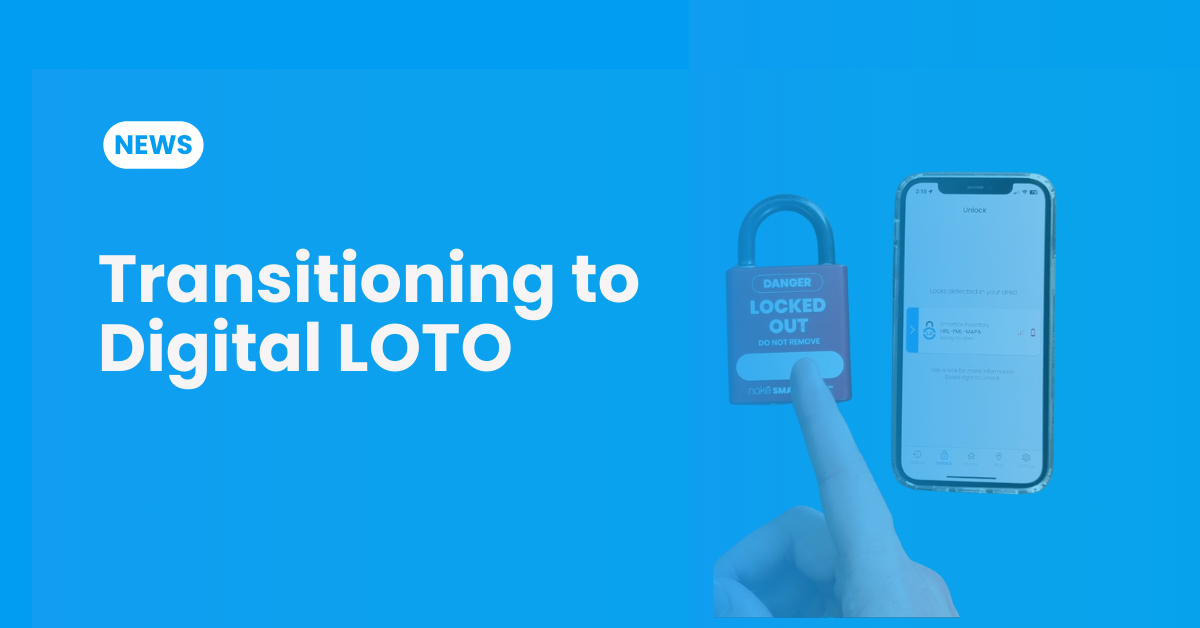
The Future of Workplace Safety: Transitioning to Digital Lockout-Tagout Systems
Transitioning to Digital Lockout-Tagout Systems In the world of industrial, mining, and manufacturing, controlling hazardous energy is a life-saving necessity. For decades, traditional Lockout-Tagout (LOTO) practices have remained largely unchanged since the 1980s. However, as operations become more complex, these manual methods are showing their age — often proving to be time-consuming, error-prone, and costly. Modern technology is finally offering a solution. By leveraging cloud computing, Bluetooth, and mobile devices, businesses can now implement Digital Lockout-Tagout systems to enhance safety and efficiency. Why Go Digital? Digital LOTO systems represent a complete overhaul of safety management. Key benefits include: Enhanced Accountability: Every action is electronically recorded, ensuring all participants are individually identified. Improved Visibility: Real-time data provides all participants with up-to-date information, ensuring perfectly coordinated safety activities. Reduced Costs: Digital systems eliminate the need to cut or replace lost locks and dramatically reduce setup time for complex group lockouts. Greater Flexibility: Software-based tools enable safety procedures to better match a business’s specific maintenance needs. How It Works: The Virtual Lockbox At the heart of a Digital LOTO system are four main components: an electronic lockout device (a Bluetooth padlock), a mobile app, SmartTags, and cloud services. The most revolutionary feature is the Virtual Lockbox. In a traditional setup, workers place physical keys into a physical box and snap their personal locks onto it. In a digital system: An authorized employee locks the equipment using an electronic padlock and a digital key. That digital key is placed in a Virtual Lockbox in the cloud. Every worker involved then applies a Virtual Personal Lock to that lockbox via their smartphone. The digital key remains encrypted and inaccessible until every worker has removed their virtual lock, ensuring no one can re-energize the machine while someone is still working. Meeting Regulatory Standards One of the biggest questions for safety managers is whether digital systems meet strict regulatory requirements, such as those from OSHA. The Digital LOTO system is designed to meet the intent of OSHA 29 CFR § 1910.147. By using individual authentication and encrypted keys, these systems provide a level of protection equivalent to, or even greater than, traditional physical locks. Digital records also make it easier for management to oversee compliance and maintain the “authorized employee” hierarchy required by law. Summary The transition to digital is more than a technical upgrade; it’s a commitment to a more transparent and reliable safety culture. By moving away from manual, paper-based records and physical key management, companies can reduce operating costs while providing their most valuable asset — their workers — with the highest level of protection available. Want to learn more? Check out our whitepaper on Digital Lockout-Tagout: SL-WP-3-02-V2